
Amazon
Ensure you have provided credentials to ship with Amazon.
Amazon - Ship With Amazon requirements
Prior to shipping with Amazon - Ship With Amazon, you must configure credentials in the Shipium Console. You'll provide an Amazon Business ID for production and test mode.
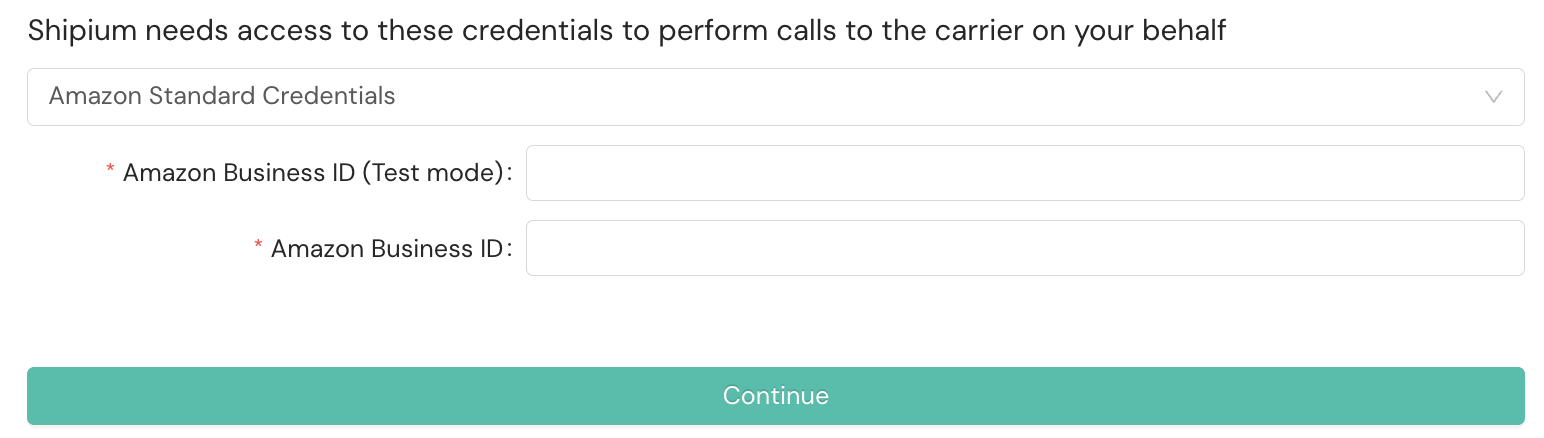
Potential values for the Amazon Business ID are included in the following table.
| Amazon Business ID | Description |
|---|---|
| AmazonShipping_US | The United States Amazon shipping business |
| AmazonShipping_IN | The India Amazon shipping business |
| AmazonShipping_UK | The United Kingdom Amazon shipping business |
| AmazonShipping_IT | The Italy Amazon shipping business |
| AmazonShipping_ES | The Spain Amazon shipping business |
| AmazonShipping_FR | The France Amazon shipping business |
| AmazonShipping_JP | The Japan Amazon shipping business |
Amazon - Ship With Amazon's service methods and their identifiers are listed on the Supported Carriers page.
Account registration verification for Ship With Amazon
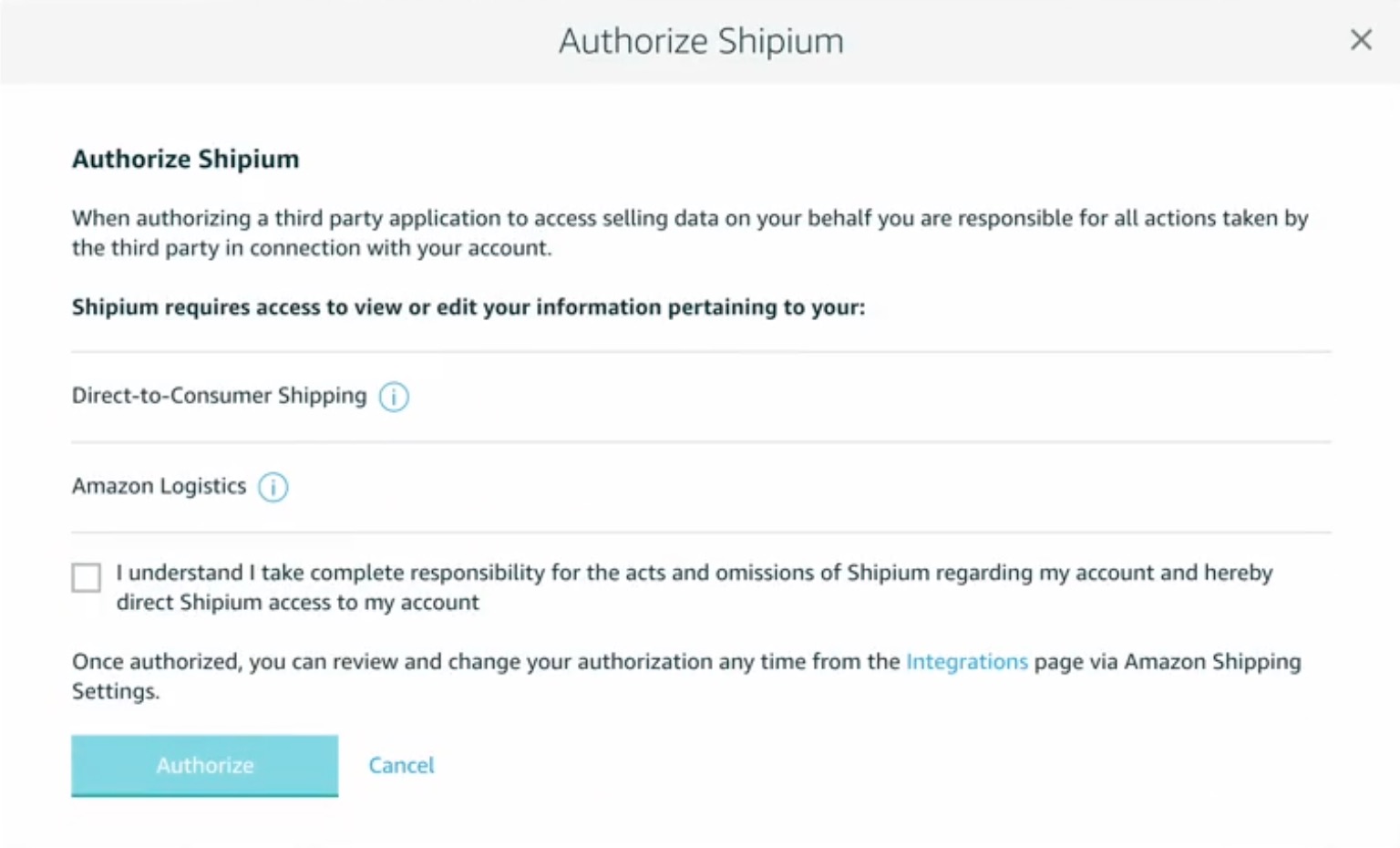
In addition to providing required credentials, you'll need to verify your account registration via Ship With Amazon. Your dedicated Implementation Team member will assist you with account setup and verification. Once your Ship With Amazon account has been created in the Shipium platform, your Shipium contact will send you a URL link for account registration verification via your web browser. You'll see an authorization modal like the one below. You will need to check the box next to the "I understand" statement and select the Authorize button. Then you'll see a success message that your registration was verified.
API call requirements for Ship With Amazon
When shipping with Amazon - Ship With Amazon, you must include the required fields listed in the following table in your API call. A sample call to our Carrier and Method Selection & Shipment Label API is included in this documentation. For multi-parcel shipments, these required fields would be included in the multiParcelShipmentParameters.
Required fields
| Request field | Details |
|---|---|
shipmentParameters .orderSourceName | Type: String Description: The source of the order that was placed; if the source is Amazon Marketplace, you'll enter amazon for this value. |
shipmentParameters .orderItemQuantities .itemWeight.weight | Type: Number (float) Description: The value of the weight; this value may also be included in customsInfo.customsItems.customsWeight.weight. |
shipmentParameters .orderItemQuantities .itemWeight.weightUnit | Type: String (enumeration) Values: g (gram) or kg (kilogram) or oz (ounce) or lb (pound)Description: The unit in which weight values are provided; this value may also be included in customsInfo.customsItems.customsWeight.weightUnit. |
Conditional fields
| Request field | Details |
|---|---|
shipmentParameters.carrierProcessingId | Type: String Condition: Required if the value provided for orderSourceName is amazon Description: Carrier-provided identifier; this is the purchase order number from the order step via Amazon. |
shipmentParameters.orderItemQuantities .hazmatInfo.packingInstructionCode | Type: String (enumeration) Condition: Required for international shipments and shipments containing hazardous materials Values: PI965_SECTION_IA (Ion PI965 Section IA [LiBa]), PI965_SECTION_IB (Ion PI965 Section IB [LiBa]), PI965_SECTION_II ([LiBa]), PI966_SECTION_I (Ion PI966 Section I [LiBa with equipment]), PI966_SECTION_II (Ion PI966 Section II [LiBa with equipment]), PI967_SECTION_I (Ion PI967 Section I [LiBa in equipment]), PI967_SECTION_II (Ion PI967 Section II [LiBa in equipment]), PI968_SECTION_IA (Metal PI968 Section IA [LiBa]), PI968_SECTION_IB (Metal PI968 Section IB [LiBa]), PI969_SECTION_I (Metal PI969 Section I [LiBa with equipment]), PI969_SECTION_II (Metal PI969 Section II [LiBa with equipment]), PI970_SECTION_I (Metal PI970 Section I [LiBa in equipment]), PI970_SECTION_II (Metal PI970 Section II [LiBa in equipment])Description: The specific packing instruction of the item being shipped |
Customs item to order item quantity mapping
For international shipments with Amazon - Ship With Amazon, accurate customs declaration requires a precise mapping between the items declared in your customs information and the corresponding items within each package. Shipium facilitates this by connecting the productId values in your customsInfo.customsItems with the productId values in your package's orderItemQuantities.
You can find more information in Customs Info for Shipments.
Amazon - Vendor Direct Fulfillment requirements
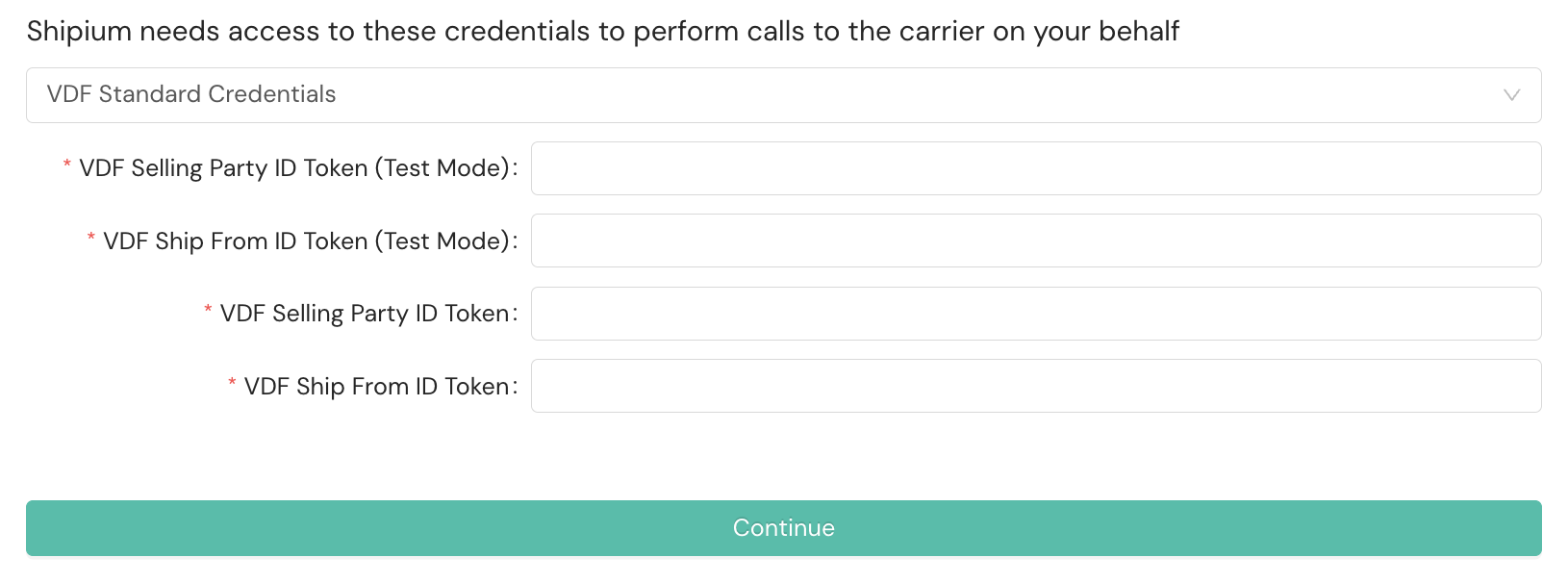
Prior to shipping with Amazon - Vendor Direct Fulfillment, you must configure credentials in the Shipium Console. You'll provide a VDF Selling Party ID Token and a VDF Ship From ID Token for production and test mode. The VDF Selling Party ID Token credential is your Amazon-related Selling Party value, or the vendor code assigned to the vendor. You'll enter your Amazon Ship From Party value, or the warehouse code assigned to the warehouse, for the VDF Ship From ID Token credential.
Amazon - Vendor Direct Fulfillment's service methods and their identifiers are listed on the Supported Carriers page.
Account registration verification for Vendor Direct Fulfillment
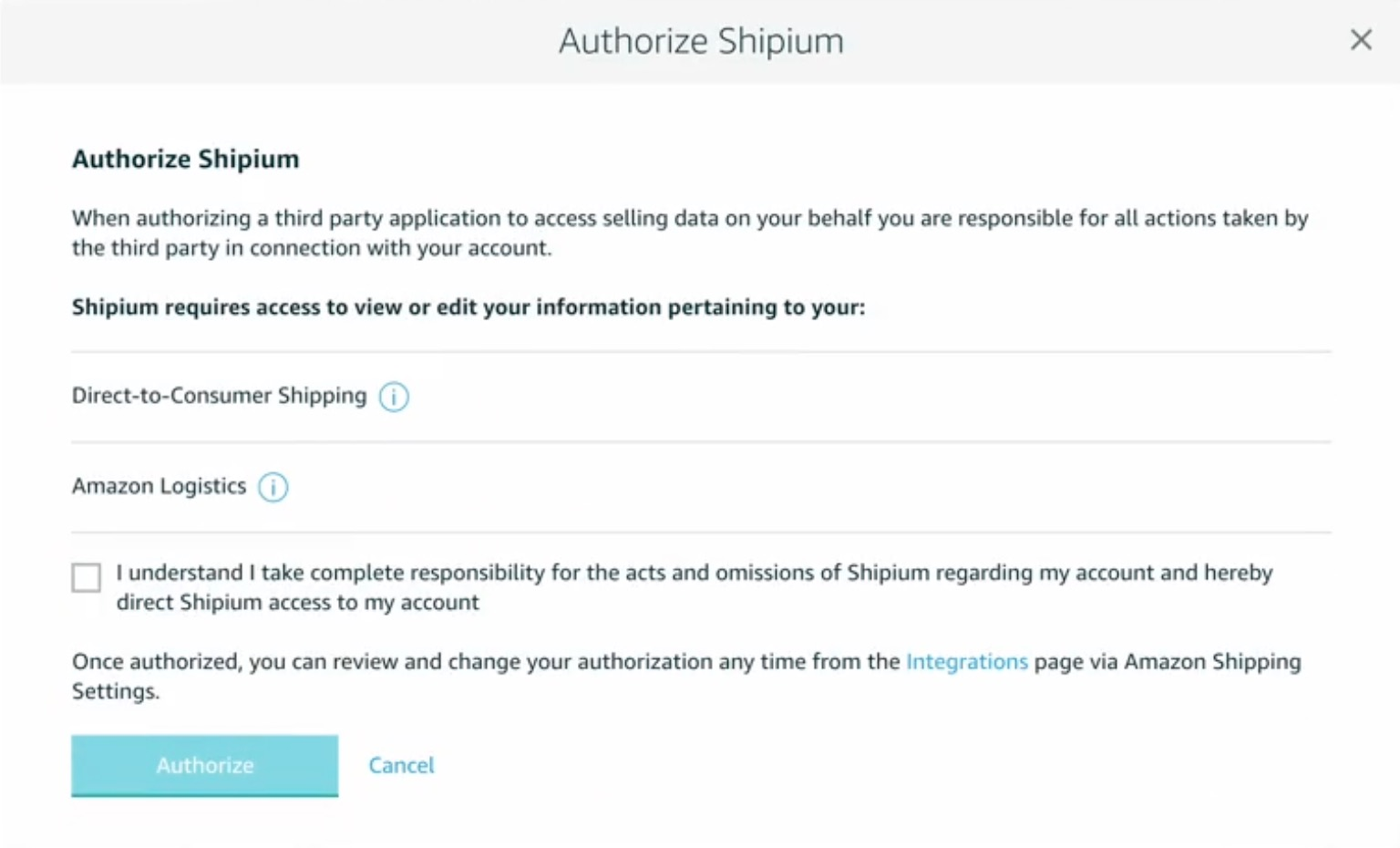
In addition to providing required credentials, you'll need to verify your account registration via Vendor Direct Fulfillment. Your dedicated Implementation Team member will assist you with account setup and verification. Once your Vendor Direct Fulfillment account has been created in the Shipium platform, your Shipium contact will send you a URL link for account registration verification via your web browser. You'll see an authorization modal like the one below. You will need to check the box next to the "I understand" statement and select the Authorize button. Then you'll see a success message that your registration was verified.
API call requirements for Vendor Direct Fulfillment
All API calls for Amazon - Vendor Direct Fulfillment must have test mode set to a value of "false", as Vendor Direct Fulfillment does not support test mode. Any requests sent with testMode=true will fail. In addition, since all testing must be performed in production mode, you must use real, valid purchase orders. The purchase order number should be unique for each call and should not be reused.
When shipping with Amazon - Vendor Direct Fulfillment, you must include the required fields listed in the following table in your API call. A sample call to our Carrier and Method Selection & Shipment Label API is included in this documentation. For multi-parcel shipments, these required fields would be included in the multiParcelShipmentParameters.
Required fields
| Request field | Details |
|---|---|
shipmentParameters.carrierProcessingId | Type: String Description: Carrier-provided identifier; this is the purchase order number from the order step via Amazon. |
shipmentParameters.packageReferenceIdentifier | Type: String Description: Used to correlate parcels to label documents from the carrier; this is the container identifier that Amazon uses as a parcel identifier. |
shipmentParameters.orderItemQuantities .orderItemReferenceIdentifier | Type: Integer (int32) Description: A carrier-provided identifier that references the order item; this is the item sequence number returned from Amazon during the order placement step. |
shipmentParameters.orderItemQuantities .productId | Type: String Description: A product ID for the product being checked; this is the vendor product identifier you received from Amazon in the purchase order. |
shipmentParameters.orderItemQuantities .quantity | Type: Integer (int32) Description: The number of units of this product |
shipmentParameters.packagingType .packagingWeight.weight | Type: Number (float) Description: The value of the weight |
shipmentParameters.packagingType .packagingWeight.weightUnit | Type: String (enumeration) Values: g (gram), kg (kilogram), oz (ounce), lb (pound)Description: The unit in which weight values are provided |
Amazon - Seller Fulfilled Prime (SFP) requirements
Amazon Seller Fulfilled Prime (SFP) allows you to display the Prime badge on eligible products while fulfilling orders from your own warehouse. Integrating SFP with Shipium enables you to leverage Shipium's carrier selection optimization while meeting Amazon's Prime delivery requirements.
Amazon - Seller Fulfilled Prime's service methods and their identifiers are listed on the Supported Carriers page.
Prerequisites for Seller Fulfilled Prime
Before configuring Amazon SFP in Shipium, ensure you have:
- An active Amazon Seller Central account enrolled in the Seller Fulfilled Prime program
- Your Amazon Business ID (see the Ship With Amazon requirements section above for available values)
- An existing fulfillment context in Shipium where you want to enable SFP
- Authorization to complete the Amazon account registration verification process
Key configuration decisions for Seller Fulfilled Prime
The following decisions will shape how Amazon SFP operates within your fulfillment network. Your Shipium Implementation or Customer Success team will assist you with the technical setup in the Shipium Console.
Fulfillment context selection
Determine which fulfillment context should include your Amazon SFP carrier contract. Consider which warehouses will fulfill SFP orders, which other carriers operate alongside SFP in this context, and whether the context will be used exclusively for Amazon orders or serve multiple channels.
Contract naming and identification
Choose a clear naming convention for your SFP contract. You'll provide a human-readable contract name that distinguishes this contract from others (e.g., "Amazon SFP - East Coast DC"). You may also provide an optional unique identifier, which is a case-sensitive ID for API references if your systems will programmatically interact with this contract.
Rating type configuration
Amazon SFP contracts should use Carrier Rating as the rating type. This is because Amazon determines the shipping rates for SFP orders. You'll select this option during carrier rate configuration.
Console configuration for Seller Fulfilled Prime
Prior to shipping with Amazon - Seller Fulfilled Prime (SFP), you must configure credentials in the Shipium Console. Select "Amazon Standard Credentials" and provide an Amazon Business ID for production and test mode.
Potential values for the Amazon Business ID are included in the Ship With Amazon requirements section above.
Carrier configurables for Seller Fulfilled Prime
After configuring your SFP carrier settings, you can customize SFP-specific options in the Carrier Configurables section of Carrier Settings. These options control how Shipium optimizes carrier selection for your SFP shipments.
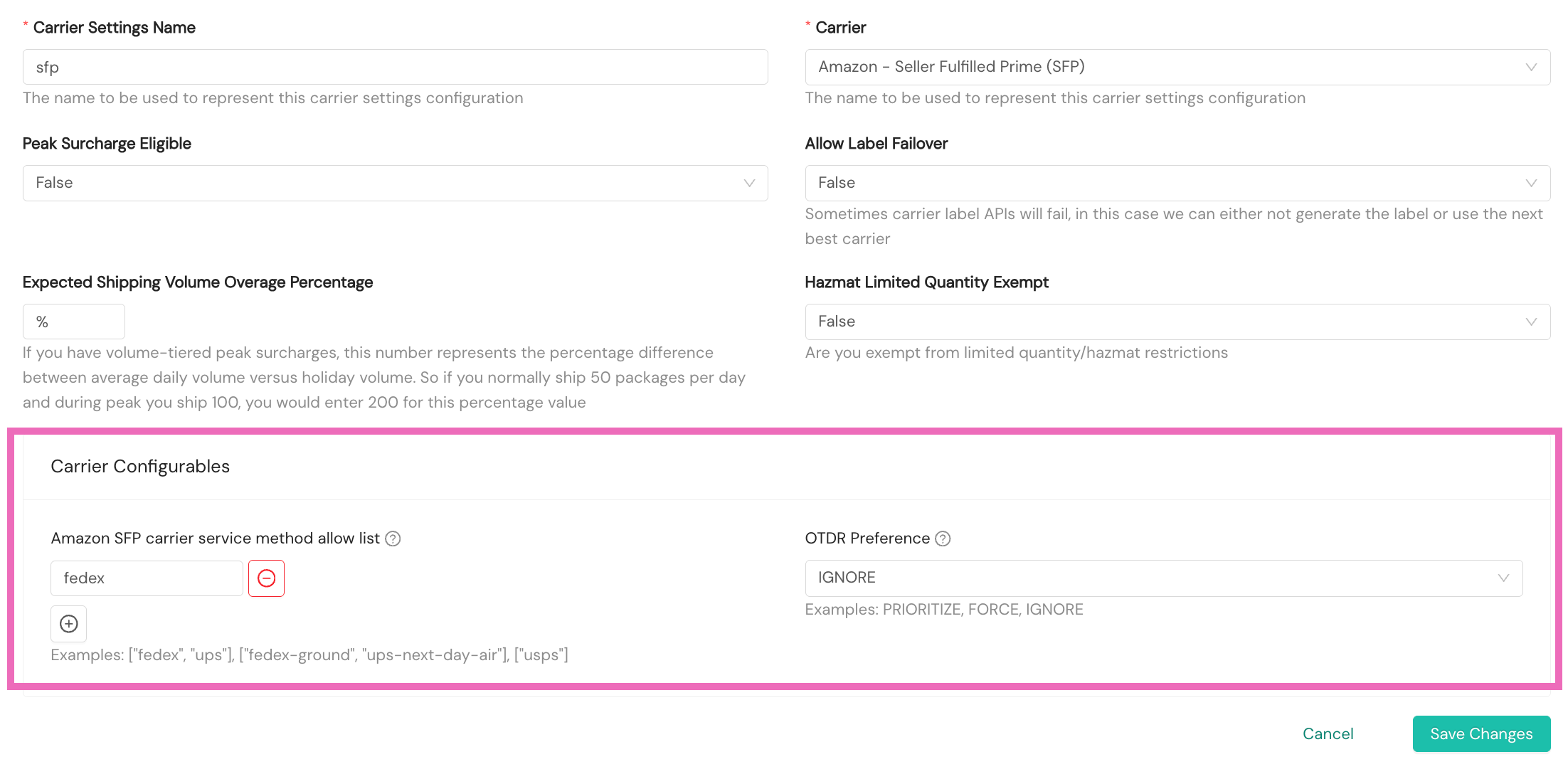
| Configuration option | Details |
|---|---|
| Amazon SFP carrier service method allow list | Type: List of strings Required: No Description: Restricts the SFP rate shop to only the carriers or service methods you specify. Each entry can be a carrier identifier (e.g., fedex or ups) or a specific service method identifier (e.g., fedex-ground or ups-next-day-air). Matching is case-insensitive. When this list is configured, SFP-eligible service methods are filtered to only those matching an entry in the list. Carrier and service method identifiers are provided in Supported Carriers. |
| OTDR Preference | Type: String (enumeration) Required: No Default: PRIORITIZEValues: PRIORITIZE, FORCE, IGNOREDescription: Controls how On-Time Delivery Rate (OTDR) protection is considered during SFP rate shopping. OTDR-protected service methods include insurance that protects against missed delivery commitments. For Amazon SFP orders, meeting Prime delivery windows is critical to maintaining your Prime seller status. |
The available values for OTDR Preference are described in the following table.
| OTDR Preference value | Behavior |
|---|---|
PRIORITIZE (default) | Prefer OTDR-protected service methods, even if slightly more expensive. If no protected options are available, fall back to non-protected service methods. |
FORCE | Only consider OTDR-protected service methods. If no protected options are available, the rate request will fail. |
IGNORE | OTDR protection is not considered during filtering. Service methods are evaluated regardless of OTDR protection status. |
When Shipium processes an SFP rate request, it applies these configurations in the following order: carrier service method allow list filtering, then OTDR preference filtering, then delivery date evaluation, and finally cheapest rate selection.
Configuration requirements summary for Seller Fulfilled Prime
The following table summarizes the required and optional configuration elements.
| Configuration element | Required? | Notes |
|---|---|---|
| Fulfillment context | Yes | Must exist before adding SFP contract |
| Contract name | Yes | Unique name for identification |
| Amazon Business ID | Yes | See Ship With Amazon requirements for available values |
| Credentials | Yes | Select "Amazon Standard Credentials" |
| Rating type | Yes | Should be set to "Carrier Rating" |
| Unique identifier | No | For API integration purposes |
| Carrier service method allow list | No | Restrict which carriers or service methods are considered |
| OTDR Preference | No | Prioritize on-time delivery insurance; defaults to PRIORITIZE |
Account registration verification for Seller Fulfilled Prime
In addition to providing required credentials, you'll need to verify your account registration via Seller Fulfilled Prime. Your dedicated Implementation Team member will assist you with account setup and verification. Once your Seller Fulfilled Prime account has been created in the Shipium platform, your Shipium contact will send you a URL link for account registration verification via your web browser. You'll see an authorization modal similar to the one shown in the Ship With Amazon account registration section above. You will need to check the box next to the "I understand" statement and select the Authorize button. Then you'll see a success message that your registration was verified.
ImportantThe person completing this verification step must have the appropriate Amazon Seller Central permissions to authorize third-party integrations.
API call requirements for Seller Fulfilled Prime
When shipping with Amazon - Seller Fulfilled Prime, you can include the optional field listed in the following table in your API call to the Carrier and Method Selection & Shipment Label API.
Optional field
| Request field | Details |
|---|---|
shipmentParameters.orderItemQuantities.serialNumbers | Type: Array of strings Required: No Description: Serial numbers for the order item. Amazon SFP requires serial number reporting for certain product types, such as high-value or warranty-bearing items. The number of serial numbers provided must not exceed the item quantity. If omitted, null, or an empty array, the field is excluded from the carrier request. |
Resources
Your Shipium team member is available to help along the way. However, you might find these resources helpful:
Updated 4 months ago