
Carrier Failover
Designate a carrier as being allowed to fail over when there is an issue with a call to the carrier.
About carrier failover
In some cases you may have carriers that are less reliable, but who you retain because of low prices or some other advantage. We think of these as best-effort carriers.
If you want to be able to add them into your shipping mix, but you do not want them to prevent associates from shipping packages, then you can mark them as being allowed to fail over when there is an issue calling that carrier.
Warning! Dangerous featureThis feature should be used with great care. If configured and triggered, it will mean that Shipium is choosing to USE A MORE EXPENSIVE CARRIER if there is a failure on this carrier's part.
Configure a carrier to allow label failover
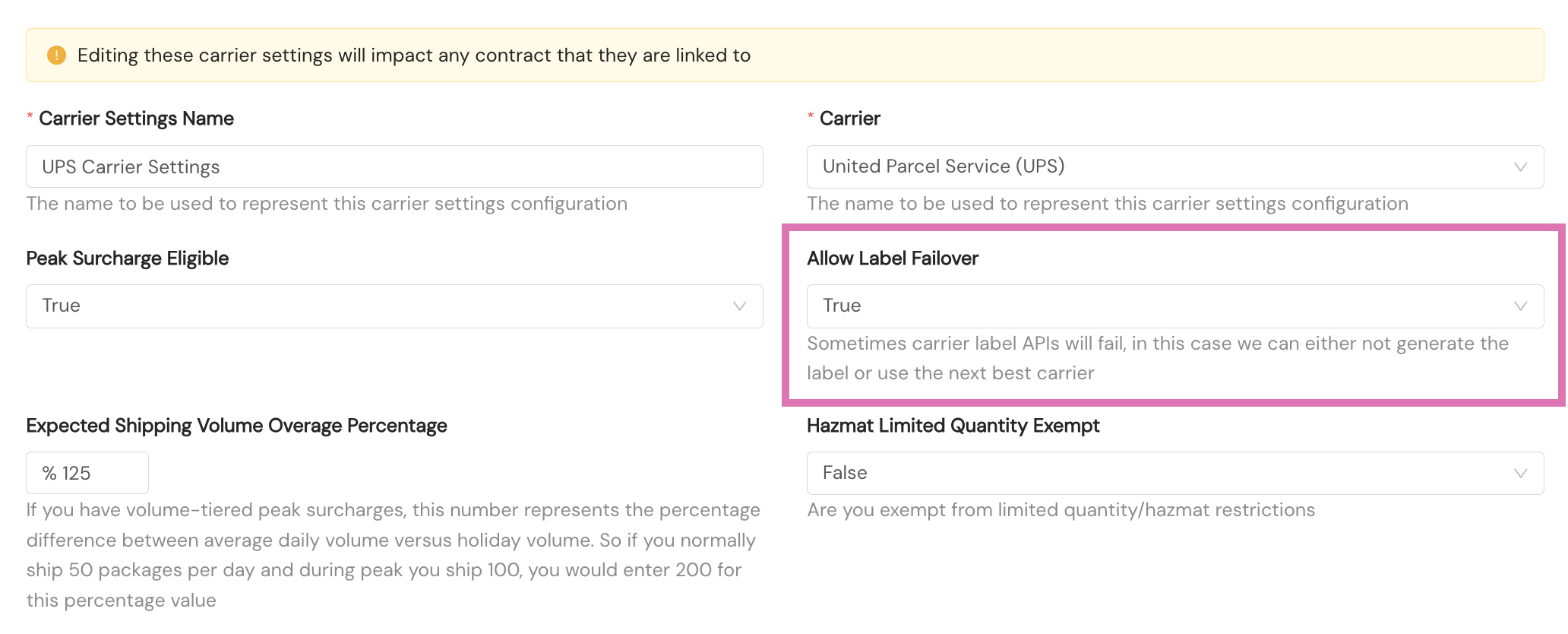
The Carrier Contracts documentation describes setting up a carrier contract, including the Carrier Settings section where label failover is configured. The Allow Label Failover option, shown below, is a required True/False dropdown within Carrier Settings. When set to True, label failover is allowed. If the selected carrier can't be reached, the next-best carrier and ship method will be used. You can view the configuration and change this setting if required by selecting Edit in the Carrier Settings section.
Determine that carrier failover has occurred
If a carrier failover occurs as part of Carrier and Method Selection or Carrier and Method Selection & Shipment Labels, it can be identified by an additional set of fields that are not otherwise present:
carrierLabel.labelFailoverOccurred. If this is present and set totrue, a failover has occurred.- An additional block named
carrierLabel.labelFailoverDetails. This contains a section calledpreferredCarrierSelection, which shows the carrier and method that were not selected.
Both of these are shown in this example:
{
  ...
  "carrierLabel": {
    ...
    ...
    "labelFailoverOccurred": true,
    "labelFailoverDetails": {
     ...
        "preferredCarrierSelection": {
                "carrier": "fedex",
                "carrierAccountId": "a2145a5d-ac70-4fbc-9080-9639841fe65b",
                "carrierSelectionDateTime": "2021-05-21T17:31:55.765Z",
                "carrierSelectionId": "f9b011e6-c3ec-427c-a6a2-6257b4bca940",
                "partnerId": "f62d137a-2e7a-4c32-b0ba-594a113423b8",
                "serviceMethodName": "ground",
                "serviceMethodUrn": "bd322745-a7f2-451e-a9c3-661b73422ce5",
                "totalCost": 0
       }
      ...
    }
  }
}
Understanding carrier data after failover
When you retrieve shipment data via API, you'll see two separate carrier-related objects. For an example of this response structure, see Evaluated Service Methods.
carrierSelection contains the result of the initial carrier selection process, including the originally selected carrier and service method. This object is not updated when failover occurs — it preserves a record of the original selection decision.
carrierLabel contains information about the actual label that was created, including the carrier used after any failover. When failover occurs:
carrierLabel.statuswill show failover.carrierLabel.carrierwill reflect the carrier that shipped the package.carrierLabel.labelFailoverOccurredwill be true.carrierLabel.labelFailoverDetailswill contain details about the preferred carrier that failed.carrierLabel.laneMatchwill reflect the lane associated with the carrier that shipped the package, if you use shipment lanes.
Because these two objects serve different purposes, carrierSelection.carrier and carrierLabel.carrier may show different values after a failover event. This is expected behavior.
To determine the actual carrier used for a shipment, always reference carrierLabel.carrier rather than carrierSelection.carrier.
FAQ
Q: Why do carrierSelection.laneMatch and carrierLabel.laneMatch show different lanes?
A: carrierSelection.laneMatch reports the lane chosen during the initial carrier selection, and it is not updated when failover occurs. carrierLabel.laneMatch reports the lane for the label that was actually created. On a shipment that ships on its originally selected carrier, both report the same lane. When a label failover sends the shipment to a different carrier, carrierSelection.laneMatch continues to report the original lane while carrierLabel.laneMatch reports the lane associated with the carrier that shipped the package. To determine the lane the printed label belongs to, reference carrierLabel.laneMatch. For where these fields appear in the response and their attributes, see Shipment Lanes.
Resources
More information on the API responsesAs with all Shipium API responses, this API follows the API Response Codes standards unless otherwise specified.
Your Shipium team member is available to help along the way. However, you might find these resources helpful:
Updated 4 months ago